

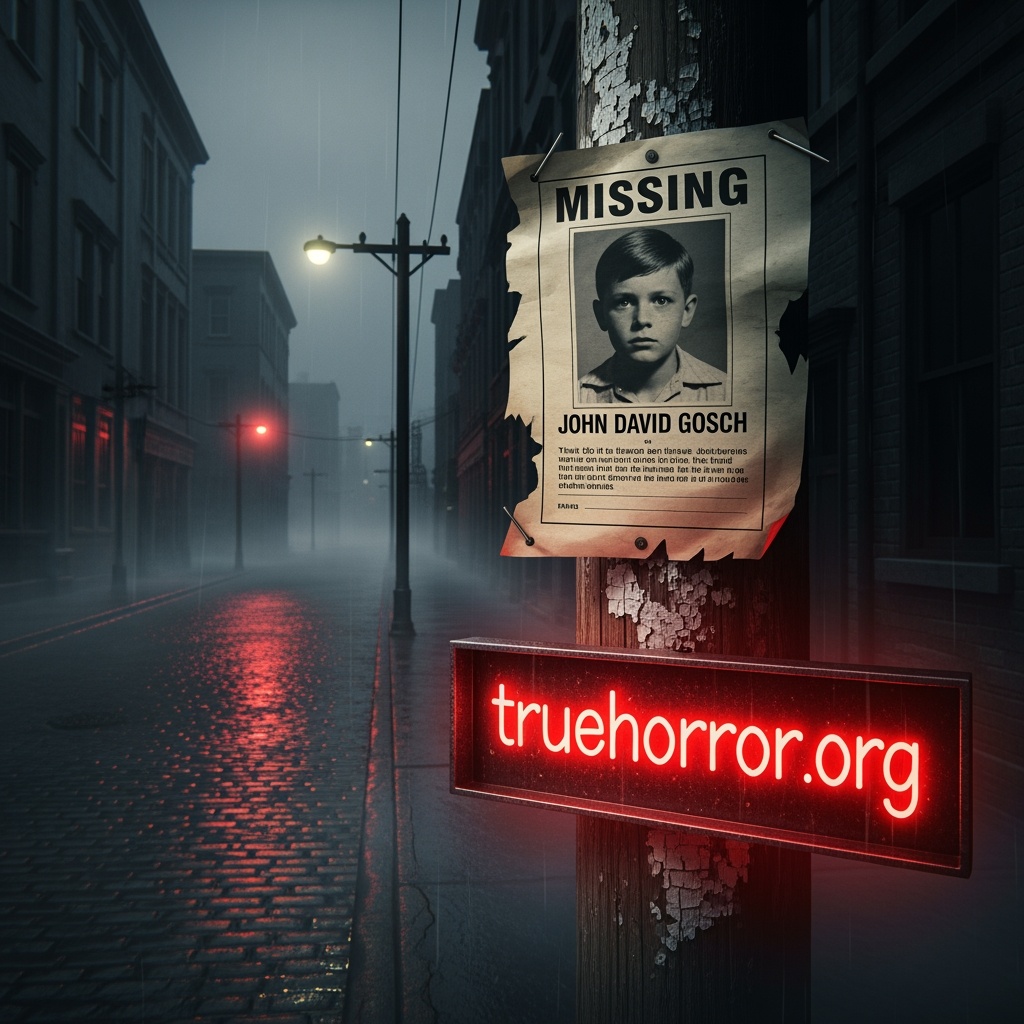
One of America’s biggest sex scandals is the case of US billionaire Jeffrey Epstein, who not only sexually abused hundreds of young girls, but allegedly ran a full-blown sex trade involving them, with clients including influential figures, whose names will hopefully be published soon. But as early as the late 1960s, there were rumors of a pedophile sex ring that reached into the highest social circles. It all began with the mysterious disappearance of 12-year-old John David Gosch, known to everyone as Johnny. John David Gosch was born on November 12, 1969, in Iowa’s capital, Des Moines. His disappearance on the morning of September 5, 1982, on his birthday, remains one of the most mysterious missing persons cases in American history. Johnny Gosch gained nationwide fame as one of the first missing children whose picture was printed on milk cartons to help in the search for him. Despite intensive efforts by the authorities and private investigators, his disappearance remains unsolved to this day. On the morning of his disappearance, Johnny unusually did not wake his father to help him with the newspaper route, but instead took only the family dog, Gretchen, with him. His red handcart was fully loaded with copies of the Des Moines Register, which he intended to deliver in the suburb of West Des Moines. But after Johnny left his parents’ house that morning, he simply disappeared. When Johnny’s parents received complaints from customers about undelivered newspapers, Johnny’s father began searching the neighborhood. He found Johnny’s cart, still full of newspapers, two blocks from their house. The police initially assumed that Johnny had run away. They refused to take further action because at that time there was a 72-hour waiting period for such missing persons cases. For this reason, Johnny’s parents organized a large search party of volunteers on their own to look for Johnny, but to no avail. It was only later that the police realized that Johnny had probably been abducted. Witness reports from other paperboys said they last saw Johnny at the paper collection point, where another boy named Mike saw him talking to a stocky man in a blue and white Ford Fairmont, who later followed Johnny. Out of sight, witnesses heard the slam of a car door and the squeal of tires. Witness John Rossi later even underwent hypnosis to better remember the car’s license plate number. After the hypnosis, he believed that the license plate was from Warren County. A few months after the disappearance, a woman in Tulsa, Oklahoma, reported hearing a boy screaming for help before being dragged away by two men. Various private investigators, including Jim Rothstein and Ted Gunderson, helped the Gosch family with their search. In 1984, Johnny’s photo appeared on milk cartons alongside Eugene Martin, another missing newspaper delivery boy from Des Moines. Eugene disappeared under similar circumstances to Johnny, and a year later, Marc James Warren Allen also vanished without a trace while on his way to a friend’s house. Despite the striking similarities, authorities were unable to prove any connection between the cases. In 1985, Noreen received a frightening letter from Robert Herman Meier II, who claimed to be a member of an outlaw motorcycle club that ran a child sex ring and was involved in Johnny’s abduction. Meier demanded money for information about her son’s return, but was soon arrested for fraud. Despite the events, Noreen continues to believe Meier’s story and has criticized the FBI for its handling of the case. Another turning point came in 1989 when 21-year-old Paul A. Bonacci told his lawyer, John DeCamp, that he was a victim of a sexual network and was forced to help with Johnny’s abduction. Noreen believed Bonacci, who knew details about Johnny that only someone who knew him could know. However, the police and the FBI deemed Bonacci untrustworthy and did not interview him. Bonacci claimed that Lawrence E. King ran a sex ring involving minors and had sexually abused him for years. Lawrence E. King was a big shot in business and politics. He was not only the director of the Franklin Credit Union in Omaha and a successful businessman, but also an activist in the Republican Party. However, no one except Noreen and Bonacci’s lawyer believed his statements, which is why charges of child prostitution against King were dismissed. Instead, Paul A. Bonacci, along with Alisha Owen, also a victim of abuse, was charged with perjury by the grand jury. Ultimately, however, Paul A. Bonacci was not convicted. On February 27, 1991, the U.S. District Court for the District of Nebraska awarded him $1 million in damages and punitive damages because he had sued King, who had not responded to the civil suit. For this reason, a default judgment was issued against King. King withdrew his appeal in 2000. Lawrence E. King was not charged with child prostitution, but with fraud involving a credit union, which he allegedly embezzled $40 million from. He was sentenced to 15 years in prison and released in April 2001. Noreen Gosch, Johnny’s mother, never stopped searching for answers. She claims that Johnny visited her in 1997, accompanied by an unknown man. According to Noreen, her son told her that he had been kidnapped by a pedophile network and later released when he had become “too old.” Since then, he has been living under a different identity for fear of his life. Johnny’s father, John, who divorced Noreen in 1993, expressed doubts about this encounter. He doubts that it was actually Johnny, and much speculation suggests that it was someone posing as Johnny. The authorities were unable to locate Johnny or confirm Noreen’s report, which continues to entangle the case in a web of speculation and conspiracy theories. In 2006, the case suddenly gained renewed attention when Noreen found photos on her doorstep that were supposed to show Johnny in captivity. Some of the photos were identified as part of a case in Florida, but one boy in the pictures could not be identified. The black-and-white photo shows a boy with his mouth gagged, his hands and feet bound, and a brand on his shoulder. Noreen insists that this boy is Johnny. Noreen Gosch is deeply committed to the rights of missing children and founded the Johnny Gosch Foundation. Her tireless efforts led to the passage of the “Johnny Gosch Act,” which requires immediate police response to reports of missing children. Through her testimony before the Senate and the Department of Justice, she played a crucial role in the establishment of the National Center for Missing and Exploited Children. The case of Johnny Gosch remains a subject of intense debate and speculation to this day. Noreen firmly believes that her son is still alive and continues to hope for a reunion. The story of Johnny Gosch is a poignant example of the challenges and tragedies faced by affected families, while also demonstrating a mother’s tireless determination in the fight for the truth. Johnny’s disappearance remains a painful and unsolved mystery. However, his mother’s continued efforts and the legal reforms that resulted from his story have raised awareness of the problem of missing children and hopefully prevented many other cases. Nevertheless, the questions and pain remain for the Gosch family until the truth comes to light.
The unsolved mystery of Johnny Gosch: Victim of a pedophile child sex ring?





Leave a Reply