

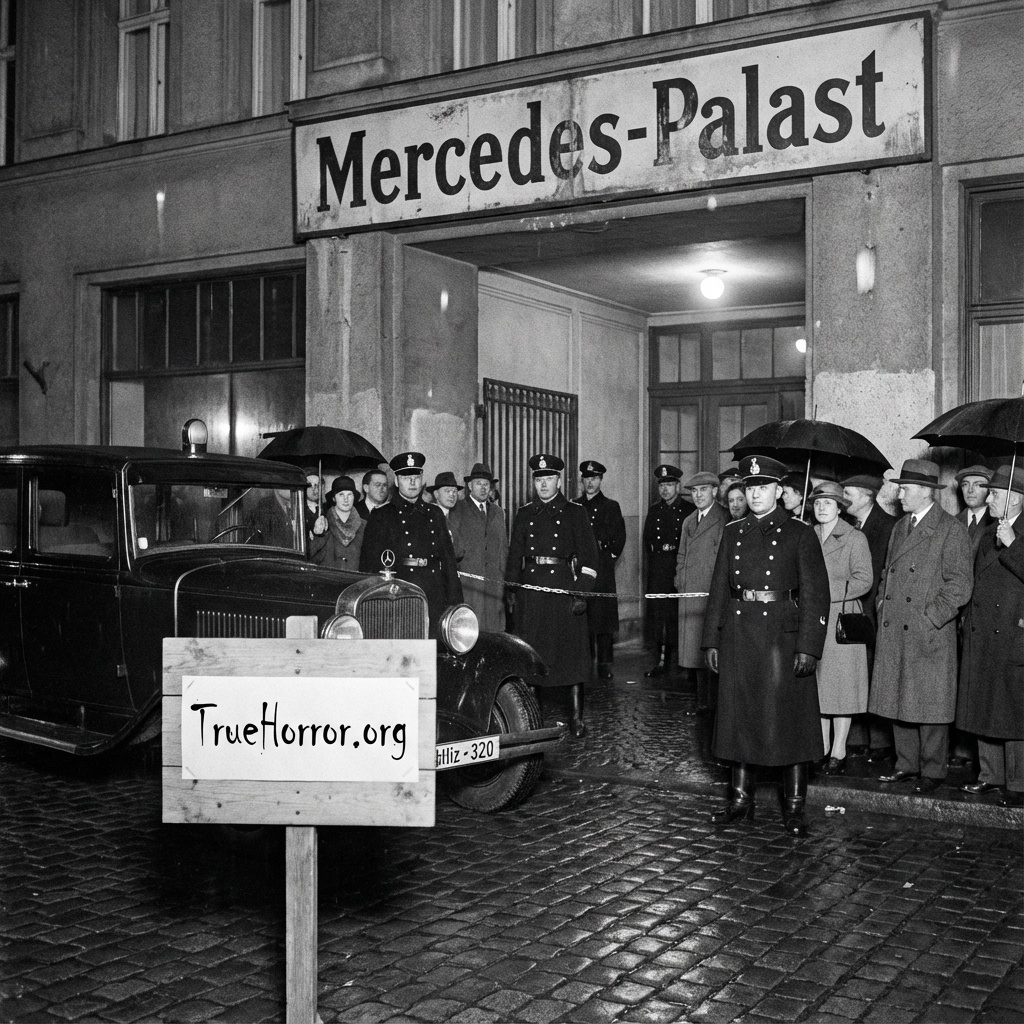
One of the most spectacular criminal cases in Berlin in the 1930s was the murder on January 20, 1931, at the Mercedes-Palast, Europe’s largest cinema and variety theater. That evening, thousands of people flocked to the Berlin entertainment temple at Hermannstraße 214 to first admire the languishing love drama “Zwei Menschen” (Two People) and then the dance group “Zwölf Argentinos” (Twelve Argentines). The Mercedes-Palast was particularly popular with the working class, as the admission prices were quite affordable. In the midst of this hustle and bustle, while the audience was carried away by the performance and made their beer-fueled comments, the program seller, Ms. Rathke, made her way to the theater office at around 9:40 p.m. to count the cash. What she discovered there made her blood run cold. Her boss, managing director Ernst Schmoller, was lying face down on the floor. On his desk was the day’s takings of 1,279.50 marks. Completely distraught, Ms. Rathke immediately called a doctor – but it was too late: Schmoller was dead. The initial diagnosis was “heart attack.” But when a detective arrived a short time later, it quickly became clear that the cause was something else. The officer opened the collar of the dead man’s shirt and discovered a small gunshot wound below the larynx. Securing evidence proved difficult, as numerous onlookers had entered the office to take a look at the body. Finally, Detective Joachim Müller from the police headquarters at Alexanderplatz arrived at the scene. He immediately assumed it was a robbery-murder, as around 600 marks were missing from the open safe, along with another 200 marks from the late show’s takings and 90 marks in silver. A 6.35 caliber bullet casing was found behind the desk, and another bullet had pierced an office door. Müller began his investigation in two directions. An unemployed actor had previously gotten into an argument with Schmoller because he had refused to give him free tickets. The actor had made serious threats against Schmoller. However, when the police arrested him in a beer bar two days after the murder, he was able to provide an alibi for the presumed time of the crime. Müller also turned his attention to 33-year-old Karl Urban, a former stage manager at “Mercedes” and now a catcher with the trapeze troupe “Die acht Nelsons” (The Eight Nelsons). Although organist Leo Kallipke claimed to have seen Urban running across the stage toward Jägerstraße at the time of the crime, Urban vehemently denied this. He stated that he had spent the entire evening and late into the night at his hotel, the Darmstädter Hof, together with snake charmers and lion tamers, and had spoken several times on the phone with his fiancée, Bettina Schenk. Witnesses confirmed his statements. Inspector Müller, also known as “Leichen-Müller” (Müller the Corpse), extended his investigations to the “ring clubs,” which were known for their criminal activities. It was known that Schmoller, a family man, had run up debts due to his affairs with women in nightclubs. But this lead also came to nothing, as did 150 other clues. With nothing left to go on, Müller decided to take another closer look at Urban. Ballistics experts determined that Schmoller had been shot with an Austrian Steyr pistol. The cartridges used were US ammunition, which was not available in Europe. Urban had purchased a “Made in Austria” weapon in front of witnesses in Mansfield and, under pressure from the suspicion of murder, now confessed to having disposed of the pistol in the hotel trash after the murder. However, it was not found. Urban’s luxurious lifestyle and his associated debts made him a suspect. In addition, his wedding to Bettina Schenck, a descendant of one of Europe’s oldest circus dynasties, was imminent. Urban wanted to invite 40 guests, which also incurred considerable costs. Furthermore, Urban had already been sentenced to 1.5 years in prison for theft in 1922. At the time, he needed money for his upcoming wedding. Müller’s team investigated the compatibility of the crime and the alibi. Was it possible for Urban to travel from the catacombs of the Mercedes Palace to the Darmstädter Hof in a maximum of 25 minutes in snowy conditions and sink the weapon in the Spree? A test drive with the car failed due to the time constraints. It was journalist Walther Kiaulehn who finally shattered the alibi by covering the distance by subway in a “blitz ride” in 17 minutes. In addition, Urban’s telephone records did not match the witness statements: his first call to Leipzig was not logged until 10:15 p.m., not 10:05 p.m. On February 2, 1931, the police arrested Urban, partly because none of his witnesses could confirm beyond doubt that Urban had been with them the entire time. Urban continued to deny the crime, which earned him the nickname “the man with nerves of steel.” During a lineup at the Mercedes Palace, several witnesses identified Urban as the fugitive, even though some had never seen him before. On February 7, Urban broke down and confessed after an intense interrogation: He had actually wanted to knock down and rob Schmoller’s predecessor, the “old Silbermann.” However, when he saw a stranger at the desk, he panicked and fired, claiming that the second shot went off by itself. Urban explained that after the crime, he fled through an emergency exit and used various means of transportation to first throw the gun into the Spree River and then get to his hotel. At the start of the trial on May 4, 1931, the public prosecutor demanded the death penalty for aggravated robbery resulting in death. Urban’s defense attorney, Prof. Dr. Dr. Erich Frey, requested a conviction for manslaughter. The court agreed with the defense’s request and sentenced Urban to eight years in prison. It was taken into account that Urban had probably not stolen any money; the missing money was probably stolen after the body was found. After the trial, Urban decided not to marry Bettina Schenck, as he did not want to burden her with a marriage to a convict. He served his entire sentence until 1939 and was then released. Urban’s lawyer Frey, who emigrated to Chile to escape the Nazis, later reported that Urban lived happily married in the Soviet zone. The murder in the Mercedes Palace was a crime that kept Berliners in suspense, and a fate that was almost lost in the turmoil of history.
The man with nerves of steel


Leave a Reply