

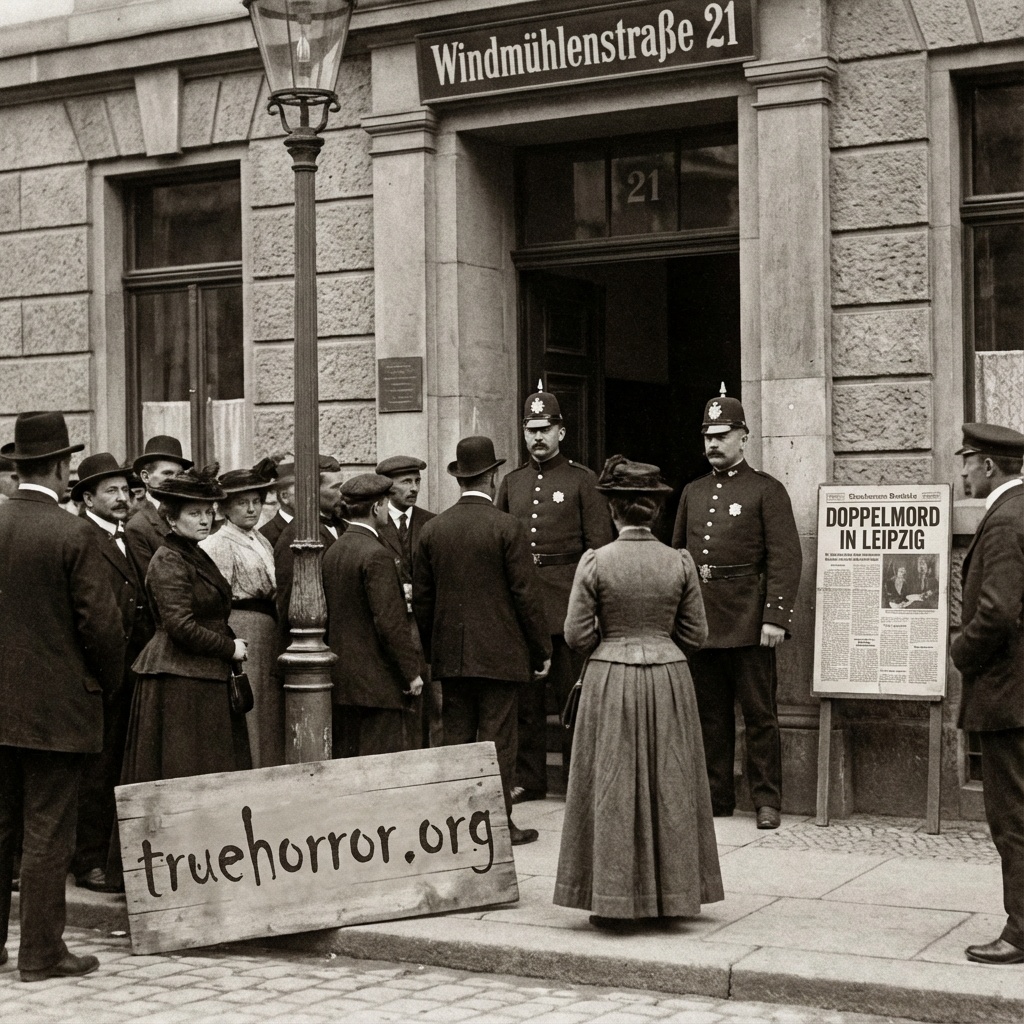
The city of Leipzig was once the most important location for German publishers and book wholesalers. These were mainly located in the Graphisches Viertel (Graphic Quarter) east of the city center. This is also where Johann Jacob Weber’s publishing houses and printing works were later located, apart from his main office in Nikolaistraße in Leipzig’s old town. Weber had published Germany’s first illustrated magazine, the so-called “Illustrirten Zeitung.” His grandson Siegfried Weber later became famous because he was blackmailed for over two years. The year was 1908. It was Christmas Eve when a letter with no return address arrived at the J.J. Weber company addressed to the publisher and bookseller Siegfried Weber. However, he did not read the letter until the morning of Christmas Day. In the letter, a man named Argus demanded that Weber deposit 5,000 marks in gold at the newspaper kiosk at the Old Theater by 6 p.m. on December 24. This was to be an advance payment for his sensational memoirs, in which he would report on 30 murders he had committed himself. Once the book was finished, Weber was to pay another 5,000 marks in gold. To prove that this was not a hoax, the man described the brutal double murder of 60-year-old typesetter Georg Friedrich and his wife Marie, whose skulls he had smashed with a hammer. In fact, on November 2, 1908, the Friedrich couple were found murdered and robbed in their apartment at Windmühlenstraße 21 by a subtenant. The Royal Ministry of Justice had offered a reward of 500 marks for information. The suspects were two well-dressed men in their mid-20s who had rented a room from the Friedrichs on October 30 under false identities for November 2, 1908. However, the police were unable to locate the two men. Since the publisher Weber had missed the deadline for handing over the money because he had opened the letter too late, he received further letters with demands from the blackmailer. Weber received a total of 12 letters, which, in addition to demands for money, also contained vicious death threats against him and his family. Weber attempted to contact the blackmailer via a newspaper advertisement, in which he had 500 marks deposited at a newspaper kiosk for the blackmailer in a letter, so that he would finally leave him and his family alone, as he had no interest in his book. But the letter was not picked up. In February 1909, the situation reached its peak when the blackmailer demanded 30,000 marks from Weber for his alleged international bestseller. Since there were no clues as to the blackmailer’s identity, the public prosecutor’s office tried to draw conclusions about the blackmailer with the help of psychologists and handwriting experts. A composite sketch was also made based on witness statements from the murder of the Friedrich couple, and the press urged the public to help. In addition, the public prosecutor’s office had increased the reward for information to 5,000 marks. On June 16, 1910, a miracle happened. Weber was handed a letter by a messenger boy. He knew that it could only be from the blackmailer and, thinking quickly, wrote a reply for the messenger boy to take to the sender. Then he rushed to his friend, who had been waiting in the car, as they had actually planned to go on a hunting trip. Instead, they hunted down the blackmailer by following the messenger boy. After a long journey, he handed Weber’s letter to a man who got out of the car as Weber approached him and fled. Weber got back into the car and took up the pursuit of the man. He achieved the impossible and, after a wild chase, caught the man, who was subsequently arrested. The man was Karl Koppius, who, together with his younger brother Fritz, had brutally murdered the Friedrich couple with a hammer. The couple had to be killed because they didn’t want any witnesses. The bloodthirsty brothers had planned a robbery of a money courier. He was lured to the Friedrichs’ apartment, where they had been staying since November 2, with a postal order that Karl Koppius had posted at the stock exchange post office on October 30. They killed the couple and waited for the money courier, who paid out the money order for 8.25 marks to Paul Schlegel, who was Karl Koppius. But instead of dragging him into the apartment and robbing him, they had to let him go because a colleague who had delivered a cash-on-delivery parcel to the same building was waiting for him. This coincidence saved the money courier’s life. After that, Karl Koppius had the crazy idea of blackmailing the publisher Siegfried Weber. He was convinced that he would write a bestseller. After Karl Koppius was arrested, his brother Fritz was also imprisoned the next day. In the course of the investigation, the brothers confessed to various crimes. The murder weapon in each case was a hammer, which is why the brothers went down in Leipzig’s criminal history as the hammer murderers. On October 5, 1910, Karl and Fritz Koppius were sentenced to death. However, Fritz was pardoned by the King of Saxony, who commuted the death sentence to life imprisonment. This sealed the fate of the murderous brothers.
The insane blackmail of the Leipzig hammer murderers



Leave a Reply