

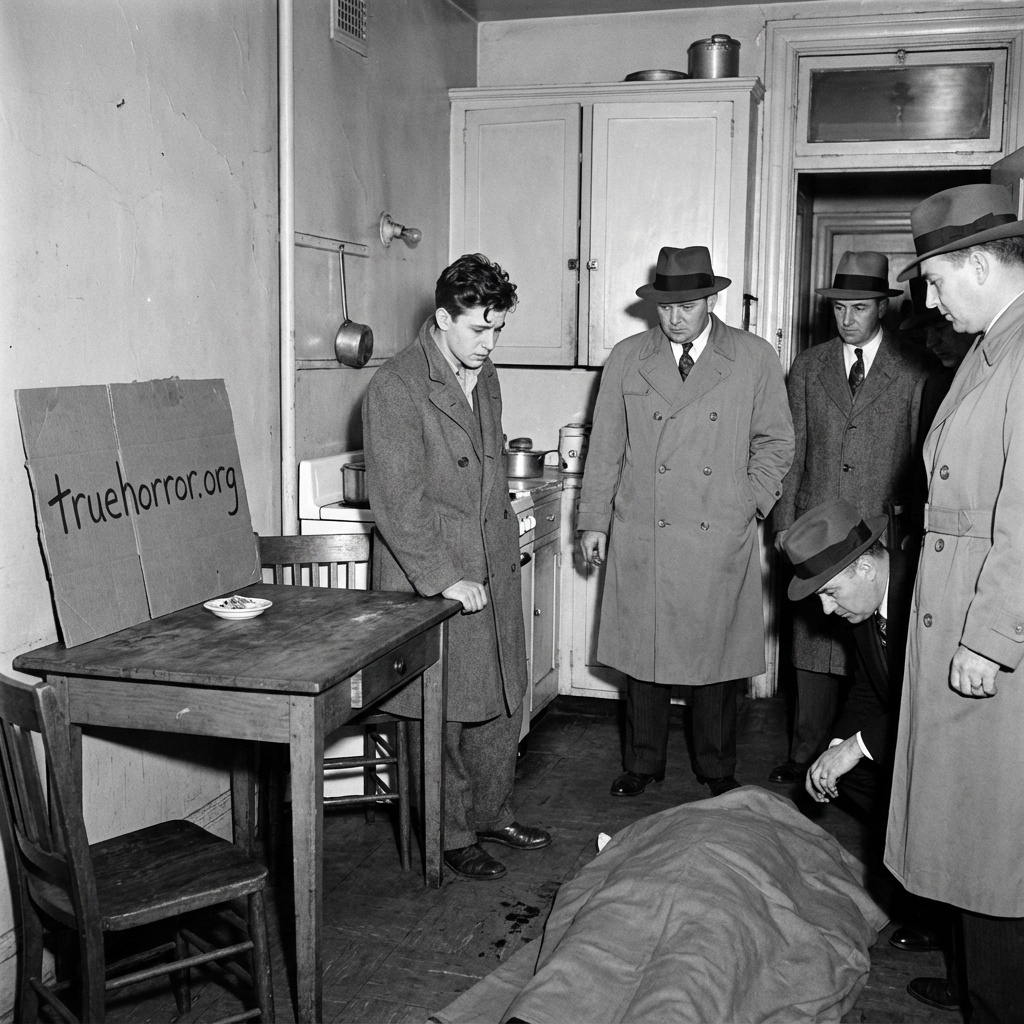
The last murderer sentenced to death and executed in Austria was Johann Trnka. He was a robber and murderer who had brutally murdered two women in Vienna. When student Heinrich Koller arrived at his mother’s apartment at Albertgasse 55 in Vienna’s 8th district, Josefstadt, on April 9, 1946, he found his 51-year-old mother, Hermine Koller, lying dead on the kitchen floor. The apartment had been ransacked for valuables. A ring, cash, and food stamps were missing. The Viennese detectives were certain that a robber-murderer had been at work here when they found a blood-stained axe in a room damaged by bombs. This turned out to be the murder weapon with which Hermine Koller had been killed. After only eight days, on the morning of April 17, 1946, chemist Dr. Wilhelm Partisch reported to the police that he had found his domestic helper Marie Bogner dead in his apartment in Vienna’s 9th district, Alsergrund. Her skull had been smashed with a blunt object. A “Radione” radio and food ration cards were missing. The fingerprints found at the scene matched those secured in Hermine Koller’s apartment. The radio station “Rot-Weiß-Rot” asked the public to go to the police immediately if a “Radione” radio was offered on the black market. In fact, a tip was received that led to the perpetrator. A man had purchased a “Radione” radio on the black market for 2,000 schillings, equivalent to 144 euros. Dr. Wilhelm Partisch identified it as his property. The seller was 34-year-old painter’s assistant Johann Trnka, who lived with his wife at Große Stadtgutgasse 13 in Vienna’s 2nd district, Leopoldstadt. However, when the police tried to arrest him on April 18, 1946, he had disappeared. Although the Vienna police were able to secure items belonging to the murder victims in his apartment as well as fingerprints, Trnka remained missing despite a reward of 1,000 schillings (72 euros) for his capture. On the day the police attempted to arrest him, he had seen the police car and fled. He stayed with a friend, where he hid for several days. He then took the train to Upper Austria. He took on odd jobs with farmers in St. Valentin and, from the beginning of December 1948, worked for a master painter in Linz until he moved into a sublet apartment in Peuerbach in February 1949. There he met a woman he wanted to marry. Almost three years passed until, in March 1949, officials at the Vienna Security Office received information that Johann Trnka was staying in Peuerbach in the district of Grieskirchen in Upper Austria, as he had requested written confirmation from the painters’ guild in Vienna. In addition, a woman from Peuerbach had called Trnka’s mother and asked about him. Johann Trnka was indeed found in Peuerbach, arrested in his apartment, and subsequently brought to Vienna. At the Vienna Security Office, Johann Trnka confessed that he had robbed and murdered the two women in April 1946. He had also planned further series of robberies. The detectives were unable to track Trnka down for a long time because he had changed his surname to Turka in a document. He submitted this to the Amstetten district administration, which issued him with an identity card under the name Truka. Everything went smoothly for three years until his new girlfriend discovered a document with his real name and called his mother in Vienna. That’s how the ball started rolling. On December 12, the jury trial against Johann Trnka took place at the Vienna Regional Criminal Court. On December 14, 1949, Johann Trnka was sentenced to death by hanging for two counts of malicious robbery and murder, seven counts of attempted robbery and murder, and embezzlement. On March 24, 1950, he was executed by hanging in the gallows courtyard of the Vienna Regional Court. He was the last murderer sentenced to death to be executed in Austria, as on May 24, 1950, the National Council decided to abolish the death penalty in Austrian criminal law with effect from June 1, 1950.
The gallows on which Johann Trnka was executed is now on display in the Vienna Crime Museum.



Leave a Reply