 Isabella Mueller (crime writer)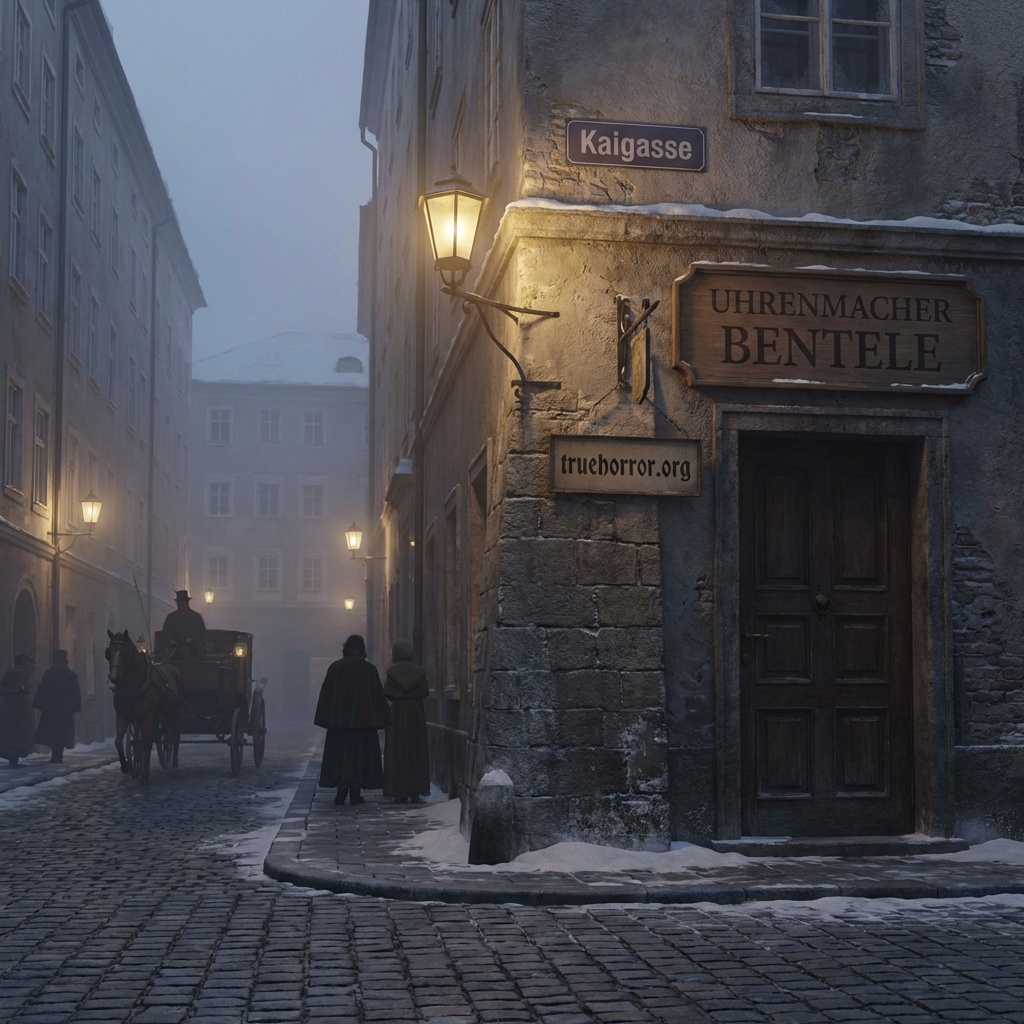
Countess Henkel von Kramschütz was a true femme fatale who instantly set every man’s heart aflutter. The attractive countess had many admirers who financed her extremely lavish lifestyle. In December 1790, the eloquent countess had moved into the house on Kaigasse in Salzburg, which belonged to the city’s well-known watchmaker Bentele. Across the street lived the prince-bishop’s accountant, Johann Aloys Brugger. He was originally from the Zillertal and had served in the Tyrolean military police before moving to Salzburg. Naturally, he was very taken with his new neighbor, who immediately poured out her heart to him. She told him that she had eloped with Wörsach from Innsbruck, who had stolen all her belongings in Luxembourg and then taken off, which is why she urgently needed money. This story opened not only Brugger’s heart but also his wallet. The beautiful young noblewoman charmed men not only in Salzburg—such as newspaper publisher Anton Hengel or city attorney Hofrat Benedict Edler von Loeß—but throughout the entire Tyrol region. After spending two weeks in Salzburg, she traveled to Innsbruck. Her journey was financed by Brugger, who also provided her with his maid. After a brief stay in Innsbruck, she continued her journey to Hall, where she received generous financial support from wealthy admirers such as Count Arco and Dr. Scala. During this time, she stayed at the home of Countess Königsfeld, who provided her with clothing and took her to theater performances. In Tyrol, the young countess made countless male acquaintances. She spent New Year’s Eve 1790 with the toll collector Haindl at the Pass Strub inn. There she met Mathe Lorenz, the clerk of the court of guardianship in Lofer. Yet it was precisely the last day of the year that proved the eloquent countess’s undoing. She had had a little too much to drink and contradicted herself during her conversations with the two gentlemen, causing them to doubt her identity. Since the countess had no identification papers, Haindl, in his official capacity, took her into custody and informed the district office. The district office initiated legal proceedings. On January 3, 1791, the countess was transferred to the Kitzbühel City and District Court. Haindl believed that the countess was Johanna Engelhärtin, who was wanted on a wanted poster. However, this so-called “beautiful Grätzen-Hannerl” was already in custody in Trieste. After the countess was taken into custody, she was interrogated on suspicion of theft and fraud. But the countess protested her innocence. She insisted adamantly that she was the daughter of General Count von Henkel of Kramschütz. This claim could not be refuted for weeks. Afterward, she claimed to be a member of the Khevenhüller von Augenthal family from Brno. When this turned out to be false, she stated that she was the daughter of Opfermann von Pflichtentreu, a citizen of Brno. She then presented herself as the daughter of Provincial Councilor von Leisser from Prague, and finally, on June 6, 1791, as an actress named Brunno. She remained tight-lipped about her wealthy patrons, as she had presented herself as married and her admirers were mostly married men; therefore, a sexual relationship would have been considered adultery under criminal law. After six months, the Tyrolean police finally established the countess’s true identity. In reality, the countess was a simple maid who had been born in Brno as the daughter of a soap maker and had grown up there in an orphanage. Later, she went to Vienna, where she worked as a maid in a house on Kahlenberggasse. She stole from her employers to use the money to travel to Prague. In the Czech capital, she worked as a domestic servant for Provincial Councilor Leiner, who taught her better manners. When, after two years, she came under suspicion of theft, she was dismissed. She moved from Prague to Salzburg, where she henceforth posed as Countess Henkel von Kramschütz and was financially supported by numerous admirers. Today, she would be comparable to a high-class prostitute, much like Rosemarie Nitribitt once was. The countess’s real name was Johanna Drackin. She was sentenced to two years of housework and manual labor in the Innsbruck prison for her fraudulent offenses, followed by deportation to Brno. A relatively lenient sentence, which she owed to her youth, her fiery temperament, and, last but not least, the fact that many of those affected waived their right to compensation. Johanna claimed she had pretended to be a countess out of poverty. After Brugger’s affair with the alleged countess became public, he was transferred to Lofer as a toll and brewery clerk. But there he got into a fierce dispute with the brewery inspector, which is why Brugger had to move to the brewery in Kaltenhausen as a second brewery clerk—a position he did not like. Eventually, Brugger was dismissed from Salzburg service due to his “unbearable arrogance.” Brugger moved to Innsbruck, where he worked as an accountant until he spent 1.5 years in pretrial detention on charges of sympathizing with the French. After his release, he moved to Vienna, where he secured a position at court. There, in 1802, he wrote a 64-page diatribe against the Salzburg officials he knew, in which he vilified them in the most vile terms, prompting the Salzburg Court Council to confiscate and subsequently destroy the work. Johanna Drackin served her sentence and was then taken to Brno; what happened to her afterward and how she lived thereafter remains unclear.